24X7 Emergency : +91-7830300210 Toll Free No: 1800-202-5100






×
Need help finding what you were looking for?
Get a call back from our Health advisor
By clicking, you agree to our Privacy Policy,
Terms of Use & Disclaimer
📞 Call: +91-7830300210
✉️ Email: info@nivokhospitals.com
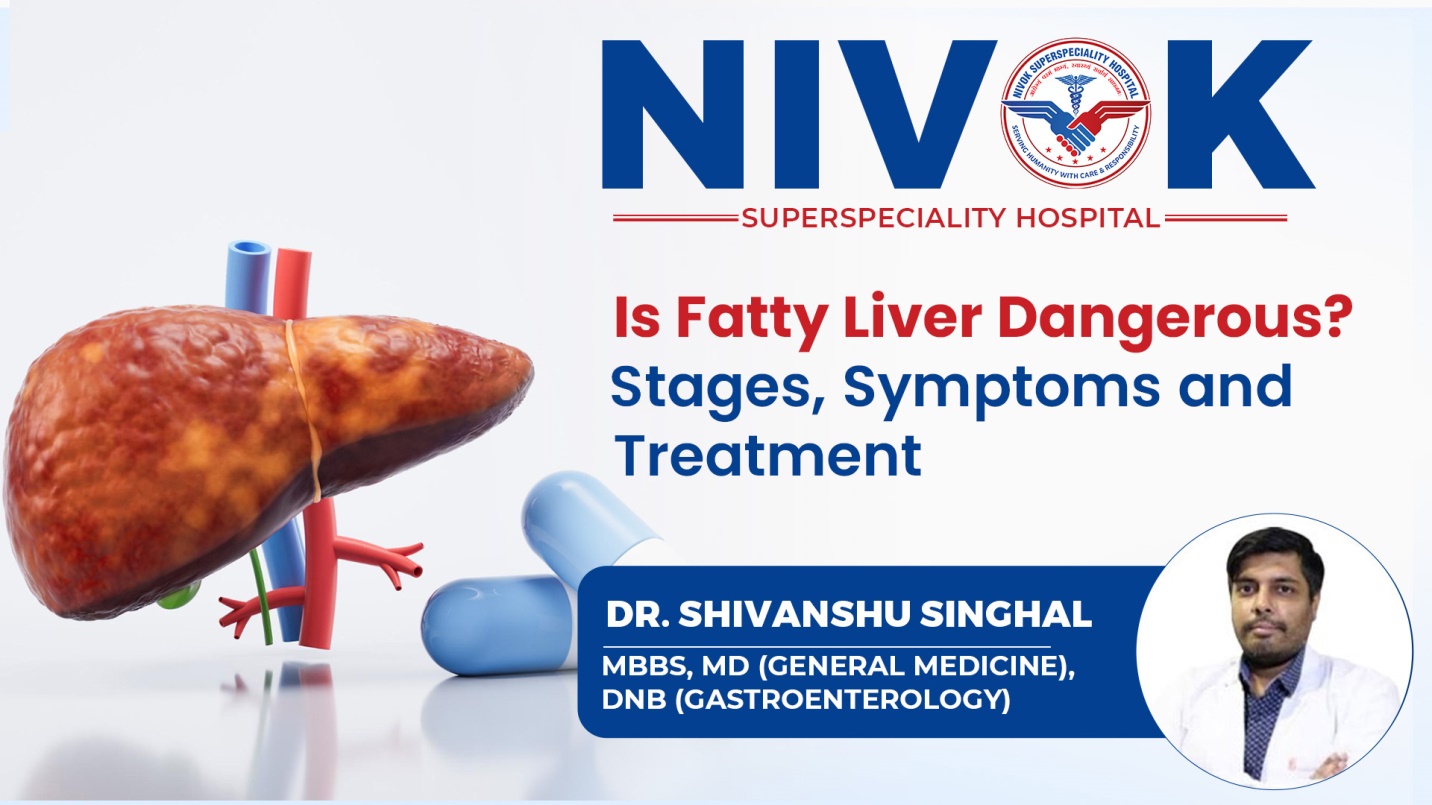
Is Fatty Liver Dangerous? Stages, Symptoms and Treatment
Is Fatty Liver Dangerous? Stages, Symptoms and Treatment
Fatty liver disease has become a fairly routine finding at checkups across Modinagar and the wider NCR region these days, and it often takes patients by surprise since it rarely produces any noticeable symptoms in its earlier stages. Most people discover they have it almost by accident, during an ultrasound or blood panel ordered for something else entirely, and the question that follows is nearly always the same one: does this actually count as serious, or is it just a minor note doctors like to flag?
The truth lies somewhere between those two extremes. Fatty liver disease can range from a fairly benign accumulation of fat within the liver all the way to a progressive condition that causes lasting, irreversible damage. Where a specific case falls along that range determines exactly how seriously it deserves to be treated.
Understanding What Fatty Liver Disease Really Is
Fatty liver disease develops when fat builds up inside liver cells beyond what's considered a healthy baseline amount. It splits broadly into two forms: alcoholic fatty liver disease, tied to heavy and sustained alcohol use, and non-alcoholic fatty liver disease, which shows up in people who drink minimal or no alcohol at all and tends to be linked instead to obesity, diabetes, and wider metabolic dysfunction. Given how common sedentary routines and processed-food heavy diets have become across urban India, the non-alcoholic version has emerged as the one doctors encounter far more often in practice.
Walking Through the Four Stages
Fatty liver disease isn't a single, static diagnosis; it moves through clearly defined stages, and each one carries its own level of risk along with a different degree of reversibility.
Stage 1: Simple Fatty Liver (Steatosis)
-
Fat builds up within liver cells without meaningful inflammation or damage
-
Generally regarded as the mildest and most reversible point in the disease's progression
-
Frequently picked up incidentally during scans done for entirely unrelated reasons
-
At this stage, lifestyle adjustments alone can often reverse the fat accumulation completely
Stage 2: Non-Alcoholic Steatohepatitis (NASH)
-
Fat accumulation advances into active inflammation along with actual liver cell injury
-
This is roughly the turning point where the condition starts becoming genuinely worrying
-
Symptoms may begin surfacing here, though a fair number of cases still stay silent even now
-
Intervening early at this stage meaningfully lowers the odds of the disease progressing further
Stage 3: Fibrosis
-
Ongoing inflammation results in scar tissue forming within the liver
-
The liver can often continue functioning fairly normally despite this scarring
-
Damage at this point stops being fully reversible, though its progression can still be slowed considerably
-
Regular monitoring becomes a necessity once fibrosis has been confirmed
Stage 4: Cirrhosis
-
Widespread scarring severely limits how well the liver can function
-
Regarded as the most serious and dangerous stage the disease reaches
-
Capable of triggering liver failure and substantially raises the risk of developing liver cancer
-
Treatment shifts focus toward managing complications and preventing further decline at this stage
Symptoms Patients Should Stay Alert To
Part of why fatty liver disease so often slips under the radar until later stages comes down to how quiet, or completely absent, its earlier symptoms tend to be.
Possible indicators of fatty liver disease include
-
Ongoing tiredness or general weakness with no clear explanation behind it
-
A mild ache or discomfort felt in the upper right portion of the abdomen
-
Weight loss that occurs without any obvious cause, more typical in advanced stages
-
Yellowing of the skin or the eyes, a sign that usually only shows up once the disease has progressed considerably
-
Swelling around the legs or abdomen, generally tied to later-stage liver damage
Since symptoms tend to stay concealed until the disease has already advanced, routine blood work and liver function testing carry particular importance, especially for people already dealing with obesity, type 2 diabetes, or elevated cholesterol.
Who Faces the Highest Risk
Certain groups carry a meaningfully greater chance of developing fatty liver disease, and knowing these risk factors helps shape when earlier screening makes sense.
Factors that raise the risk include
-
Obesity, particularly fat carried predominantly around the abdomen
-
Type 2 diabetes or existing insulin resistance
-
Elevated cholesterol or triglyceride levels
-
A largely inactive lifestyle paired with a diet heavy in processed food and sugar
-
Consistent or heavy alcohol intake
-
Certain metabolic conditions, polycystic ovary syndrome being one notable example
How It's Diagnosed and Treated
Diagnosis generally begins with blood tests measuring liver enzyme activity, followed by imaging, an ultrasound in most cases, or a fibroscan when a more detailed look at scarring is needed. Certain situations may call for a liver biopsy to get a sharper, more accurate sense of exactly how far the condition has progressed.
Treatment tends to centre around the following
-
Steady, sustainable weight loss, shown consistently to meaningfully reduce liver fat over time
-
Dietary adjustments, cutting back specifically on refined sugar, processed food, and saturated fat
-
Consistent physical activity, where even moderate exercise produces a measurable benefit
-
Keeping related conditions like diabetes, high cholesterol, or high blood pressure under control
-
Cutting out alcohol entirely, especially critical for cases tied to alcoholic fatty liver
-
Medication, used selectively to address particular complications or underlying metabolic factors
No single medication currently exists that reverses fatty liver disease outright, which is precisely why consistent lifestyle change remains the actual backbone of treatment at every stage, most notably the earlier ones that still offer real reversibility.
Why Catching It Early Genuinely Changes the Outcome
The gap between stage one and stage four fatty liver disease is, essentially, the gap between a condition that's fully reversible and one that demands lifelong management of serious complications. That's exactly why routine checkups matter so much, particularly for people already carrying risk factors like diabetes or obesity; catching the disease early gives patients a real shot at reversing it before any permanent damage takes hold.
Dr. Shivanshu Singhal at Nivok Superspeciality Hospital routinely sees patients spanning every stage of fatty liver disease and consistently points out that earlier identification translates directly into far more manageable outcomes. A fatty liver diagnosis doesn't need to feel alarming, but it shouldn't be brushed off as a trivial detail on a routine scan either. Anyone recently told they have fatty liver, or who falls into a higher risk bracket because of weight, diabetes, or general lifestyle, would do well to get a proper liver function evaluation, rather than waiting around for symptoms that might not show up until the disease has already advanced significantly.
Popular Posts

.jpg)




.jpg)
.jpg)






.png)
Copyrights © 2025 All Rights Reserved, Powered by Your Reputations Consulting
